Hit 1. Crafting Historical Arguments From Historical Evidence
Throughout the year we, the students, were required to analyze and evaluate evidence from the past from different sources such as written documents. This is shown throughout the Document Based Question essay (DBQ). The DBQ essays consists of various documents which we were supposed to elaborate on in order to support our claim. For example, in the Mongol DBQ we read and analysed documents that helped us recognize the settled peoples reaction towards mongol expansion. In order to do this, first, we had to group the documents based on reactions. Then, we extracted evidence from the documents in order to make supportable inferences and draw an appropriate conclusion using historical facts. Another thing that helped while doing the DBQ was the point of view (POV). The POV which is the position from which something is observed allows us to comprehend how a person’s position make them think a certain way. This helped us understand how reactions depended on the people's position in society. We practiced this by having to look at different documents and making them relate in order to create an appropriate thesis supported by evidence.This indicates my capacity to extract useful information in the interest of creating arguments. I have improved a lot on my thesis statements. For example, in the beginning of the year my thesis would be broad statements and were poorly supported with evidence, but as I got more practice and and saw sample thesis I started to develop my mine with appropriate and relevant historical evidence. I was able to use this in the AP Exam.
Evidence:
One of the first DBQ's we did in AP World History was the Mongol DBQ. We were required to read nine documents and analyze the settled peoples's reaction towards Mongol expansion.

|
mongol.docx Size : 29.521 Kb Type : docx |
Hit 2. Chronological Reasoning
In the past months, we use historical causation in order to identify,analyze,and evaluate the relationships between causes and effects.This was mainly through the Change and Continuity essays (CCO). The CCO essays consist of analysing and evaluating the dynamics of continuity and change over a certain period of time. I recall one time I had to do a CCO essay in which I had to analyze the changes and continuities in South Asia during the 20th century. In order to do this I had to have knowledge of what happened during this time period so I could make an appropriate theses and support it with historical evidence. As a result, this would allow me to recognize and analyze changes and continuities. For Instance, since I knew that colonial powers began to lose their grip on their colonized territories in South Asia during the 20th century then I could elaborate on how even though India gained independence and it partitioned, the official language continued to be English, the caste and religious tensions also continued. Another chronological skill that he as students continued to apply regularly was periodization. Periodization is the system which historians use to categorize events into distinct blocks. This is mainly shown in the Chinese Dynasty Song. The song allows us to remember the chronological order of the Chinese dynasties but it also divides the dynasties into periods. For example, It starts with the first dynasties, Xia and Shang, located near river valleys (2100BCE-1600BCE). This helps us identify turning points since for the first time large scale Civilizations were beginning to develop all over the world at the same time. This thought is why historians divide time periods with different dates.
Evidence:
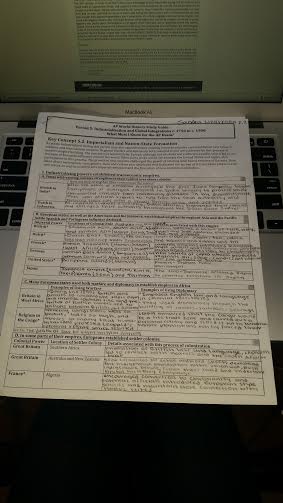
Towards the end of the first semester we were assigned a Change Over Time Essay about the Silk Roads. We had to state the change and continuity on the Silk Roads between 200 B.C.E. and 1450 C.E. I also implemented chronological reasoning in the Key Concept since it was divided my time periods and helped me understand what were the main developments during that time. For example, in Key Concept 5.2 is about Industrialization and Global Interactions between 1750 to 1900.
|
|
change over time essay Size : 20.077 Kb Type : unknown |
Hit.3 Comparison and Contextualization
Throughout the year, we, the students were required to describe, compare, and evaluate multiple historical developments. This is shown through the Compare and Contrast essays. The Compare and Contrast essays consist of identifying, comparing and evaluating multiple perspectives on a given historical experience. For example, The first essay we were assigned was comparing and contrasting China and Mesopotamia during a certain time period. In other words, we were supposed to describe and evaluate changes and continuities between two river valley civilizations during 8000BCE-600BCE. In order to create my theses i need to hit at least three spice elements, I did this by creating a spice chart for both civilizations. Due to the spice chart i was able to create an accurate thesis. For example, although these two civilizations had similar social structures, hereditary rule, and writing system, they differ in the type of government, no organized religion and strong family connections. This thesis demonstrates how the SPICE Chart helped me hit social,cultural and political claims. I was able to analyze similarities and differences between societies. As a result, the Comparison Essay helped me better understand and put into context this skill in the AP Exam since we were given a prompt that asks us to compare the Silk Roads and the Trans Saharan trade route.
Evidence:
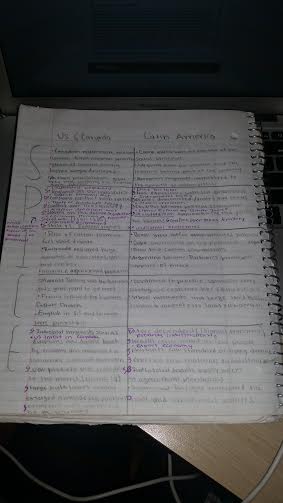
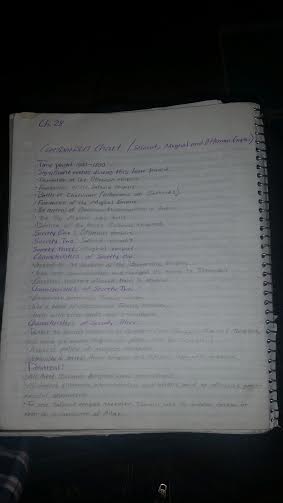
I used a SPICE Chart in order to compare US and Canada to Latin America. Also, during the Winter Break I used a comparison chart to analyze the similarities and differences of the Safavid Mughal and Ottoman Empire.
Hit 4. Historical Interpretation and Synthesis
Having been in an advance placement class he were required to use interpretation in order to describe, compare, and evaluate the past. Interpretation consists of explaining the meaning of something. For example, Mr. Rodriguez would give us reading packets which we were supposed to annotate in order to analyze different points of view regarding one development in a certain time period. The reading packet, “The Cold War” talks about the tensions between the two superpowers (The Soviet Union and The United States) and the way their conflicts impacted other societies around the world.This also helps us analyze why the United States is afraid of the spread of communism. Another example would be the packet ”A European Life”. This autobiography is written from the point of view of a boy whose family had to escape the communist regime during the Cold War. Through the analysis of points of view we can conclude that, since the writer was affected by the Cold War he opposed communism. Synthesis involves the ability to develop meaningful and persuasive understandings of the past by implementing other historical thinking skills. This is mainly shown through the concept of Social Darwinism. Social Darwinism is the theory that humans are subject to the same Darwinian laws of natural selection as plants and animals. This concept was implemented by Herbert Spencer in the 19th century and was used to justify imperialism since it claimed that the white race was the most fit, in other words, they were the superior race. It provided racism with a scientific mask. This is an example of synthesis because it helps us understand why racism still is visible especially in ex colonized areas. In conclusion, synthesis involves applying insight about the past to the present.
Evidence:
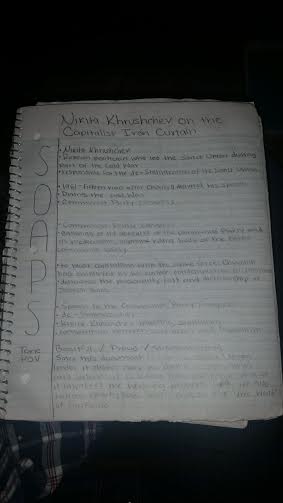
During Spring Break we, the students were required to make a Song Analysis. We were supposed to analyze a song that talked about the Cold War and identify how the Cold War affected individual. I chose the son "The Tide Is Turning" by Roger Waters. Another thing that helped me interpret documents was doing SOAP Stones with POV's. One primary source that we had to analyze was about Nikita Khrushchev on the Capitalist Iron Curtain. Developing the point of view was essential for understanding why he thinks that way.
|
|
songanalysis.docx Size : 8.617 Kb Type : docx |